
MoNaCo: More Natural and Complex Questions for Reasoning Across Dozens of Documents (TACL ’26)

We introduce MoNaCo, a benchmark of More Natural and Complex questions to evaluate the question-answering (QA) skills of language models. MoNaCo contains 1,315 time-consuming questions whose solutions involve combining and reasoning over information spanning across dozens of Wikipedia tables and passages.

Large language models (LLMs) are emerging as the go-to tool for answering questions and surfacing hard-to-find information. While LLMs (and LLM-powered applications such as Deep Research) hold great promise in solving problems that require combining knowledge from hundreds of sources, such problems are poorly represented in most model evaluation benchmarks. Existing QA benchmarks rarely feature realistic questions that are both fact-reliant and genuinely time-intensive for humans to answer. Instead, most benchmark questions are too simplistic, requiring only a handful of evidence documents, while the more complex QA benchmarks are typically machine-generated—which may result in contrived and unnatural questions.

MoNaCo addresses this gap, presenting realistic questions whose solution spans up to hundreds of documents. Furthermore, it reveals key limitations in the question-answering abilities of frontier LLMs.

In our experiments, we tested 15 frontier LLMs on MoNaCo, including GPT-5, o3, Claude Opus 4, Gemini 2.5 Pro, and Deepseek-R1. All models struggled, with the top-performing LLM, o3, reaching an F1 score of 61.2% while answering only 38.7% of examples with a perfect score.

We also observe that as solutions to questions entail reasoning over more intermediate answers or require more evidence sources, model performance decreases substantially.

About the MoNaCo Benchmark

We created MoNaCo as a QA benchmark with questions that are:

  1. Realistic, reflecting the information-seeking goals of real-world users
  2. Time-consuming, with questions that cannot be answered without potentially hundreds of intermediate facts

For example, while the two MoNaCo questions below have succinct answers, they both require dozens of fact-finding steps:

Overall, MoNaCo has 1,315 questions whose solutions involve many intermediate steps that span across dozens, and at times hundreds, of evidence documents. Compared to traditional QA benchmarks, the scope of MoNaCo questions is much broader. To solve them, models must be proficient at decomposing complex queries, locating hundreds of pieces of information, and reasoning, combining, and aggregating this data effectively.

MoNaCo’s breadth and depth makes it ideal as an LLM benchmark for at least five different settings:

  • Evaluating models’ parametric knowledge and reasoning
  • Measuring complex reasoning over long contexts, where all of the evidence docs are provided in the context
  • Multi-document retrieval performance
  • End-to-end retrieval-augmented generation (RAG)
  • Training Deep Research-like systems, using the gold standard reasoning chains

Human-Annotated Reasoning Chains

Unlike other QA benchmarks, all questions in MoNaCo come with gold-standard, human-annotated reasoning chains. Namely, for each question, we provide all the intermediate steps for its solution, as well as the answers and supporting evidence documents.

Reasoning chains are expressed as a series of decomposition steps. In the figure below, we see part of the decomposition of an example question: “In European countries, are current left-wing political parties more likely to be headed by women than right-wing ones?” Each step is either an intermediate question (qa_model) or a Python function representing a query operation (filtercount). For question steps, we provide human-annotated answers and supporting sentences/tables from Wikipedia, while for query operation steps, we provide their full execution results.

Note that the reasoning chain of the example question would be extremely time-consuming for any person to follow. Answering this question entails reviewing all political parties in each European country to note their affiliation and the leader’s gender, drawing on the equivalent of 719 Wiki pages.

Data Collection and Composition

Collecting realistic and many-step questions “in the wild” for a benchmark like MoNaCo is hard. Users tend to shy away from entering such queries into search engines, and recording them from user-AI interactions—most of which are private—poses added challenges.

For MoNaCo, we relied on annotators to write questions that reflect real-world users’ information-seeking goals. Specifically, we asked Amazon Mechanical Turk workers to write questions that would interest a particular target persona. By priming workers to assume a specific persona and not use pre-defined templates, we encouraged these workers to come up with realistic questions—helping diversify our data.

In total, we collected 1,315 complex questions, along with their intermediate steps, answers, and supporting evidence. This data includes over 90K intermediate questions with 8.5K list questions—each list having 16.2 answers on average and a median of 5 answers. For comparison, the list QA benchmarks QAMPARI and QUEST have 2K and 3.4K manually-written questions, making MoNaCo the largest benchmark of human-written list questions.

MoNaCo also contains 40K Boolean (yes/no) questions—much more than past benchmarks such as BoolQ and StrategyQA, which have 15.9K and 2.8K questions, respectively.

The intermediate answers in MoNaCo are supported by evidence from 36K distinct Wikipedia pages, with each question supported by 43.3 documents on average (median of 12). Documents are either a sentence (29.5%), a table (67.8%), or a list (2.7%). This underscores the multimodal nature of MoNaCo, as answering its questions requires reasoning across both paragraphs and tables.

Observations on Multi-Document RAG

When evaluating models in a retrieval setting, we observe two interesting phenomena.

First, in an “Oracle retrieval” setting, where all the gold evidence documents are provided to the model as input, models experience a 10-point improvement compared to the closed-book setting (no evidence provided). Nevertheless, these models reach only 58.7% F1—far from a perfect score. This indicates that even with all of the relevant knowledge provided, models still struggle with the long-context reasoning that MoNaCo questions entail.

Second, in an “end-to-end RAG” setting (with a BM25 retriever), models experience a sharp drop in performance compared to the closed-book setting. While retrieved documents may only be partially relevant, our RAG prompt explicitly instructs LLMs to ignore the documents in such cases. This lack of “retrieval robustness” has been observed in weaker models, but we find that the limitation persists even in much stronger LLMs.

Conclusion

MoNaCo can evaluate how well LLMs answer questions that require retrieving and reasoning over dozens—or even hundreds—of pieces of evidence. We hope that our work advances research on more factual and attributable AI systems.

We invite researchers to evaluate the capabilities of LLMs and retrievers on MoNaCo and to provide their feedback. Visit our website and read the paper to learn more about the MoNaCo benchmark, which is available on HuggingFace.

Paper also available on the CCG website:
Tomer Wolfson, Harsh Trivedi, Mor Geva, Yoav Goldberg, Dan Roth, Tushar Khot, Ashish Sabharwal, and Reut Tsarfaty, MoNaCo: More Natural and Complex Questions for Reasoning Across Dozens of Documents TACL (2026)

CCG Papers at ACL and ICML

The 64th Annual Meeting of the Association for Computational Linguistics (ACL) is underway in San Diego, followed next week by the Forty-Third International Conference on Machine Learning (ICML) in Seoul, South Korea. We’re excited to share the works that will be presented by the group and our collaborating authors. You can find links to our ACL and ICML 2026 papers below!

Papers from CCG collaborations:

Decomposed Prompting Does Not Fix Knowledge Gaps, But Helps Models Say “I Don’t Know” (ACL Findings)

This paper examines how different prompting strategies influence the reliability of large language models (LLMs) in closed-book question answering, with a focus on their tendency to produce confident hallucinations. It compares model responses to direct questions with those generated using question decomposition: a multi-step reasoning plan for solving the original question. The results show that discrepancies between these two prompting approaches are highly indicative of hallucinations, offering a stronger signal than prior methods such as self-consistency. 

Dhruv Madhwal and Lyuxin David Zhang and Dan Roth and Tomer Wolfson and Vivek Gupta, Decomposed Prompting Does Not Fix Knowledge Gaps, But Helps Models Say “I Don’t Know” ACL Findings (2026)

Toward Robust Evaluation for Multilingual Grammatical Error Correction: Can Large Language Models Replace Human References? (ACL)

Prior research has shown that using a <i>closest-gold reference</i> – i.e., a human reference generated with respect to the system output rather than the original text – yields more accurate performance estimates. This paper introduces <i>an automated method for generating closest-gold references</i> by prompting a large language model (LLM) with system outputs. We find that performance scores computed using automatic closest-gold references correlate well with human closest-golds, whereas standard reference-based evaluations show weak or no correlation. Building on this insight, we use both fixed human references and closest-gold references generated by Claude and Llama to compare the performance of supervised models and GPT-4 across 14 benchmarks spanning 12 languages.

Alla Rozovskaya and Dan Roth, Toward Robust Evaluation for Multilingual Grammatical Error Correction: Can Large Language Models Replace Human References? ACL (2026)

MoNaCo: More Natural and Complex Questions for Reasoning Across Dozens of Documents (TACL, presented at ACL)

The landscape of AI-powered web search is being transformed: evolving from static large language models to LLM-powered “agents” which surface hard-to-find information through multiple rounds of reasoning and retrieval. Evaluating these agents requires measuring their ability to formulate and execute long-horizon plans that demand integrating information from dozens or even hundreds of web pages. Yet existing benchmarks are largely limited to tasks involving only a handful of sources, failing to capture the recall-intensive challenges found in many real-world applications.
This paper introduces MoNaCo, the first benchmark that evaluates AI agents’ ability to answer long-horizon questions that span dozens—and in some cases hundreds—of web pages. MoNaCo consists of 1,315 human-authored questions, each paired with ground-truth answers, supporting evidence, and gold-standard reasoning chains. We evaluate 15 frontier LLMs and identify substantial performance gaps: the top-performing model, o3, achieves a perfect score on just 38.7% of the benchmark.
Using MoNaCo, we show that deep reasoning across large document collections remains an open challenge for current AI agents, and discuss promising directions for bridging this gap.

Tomer Wolfson and Harsh Trivedi and Mor Geva and Yoav Goldberg and Dan Roth and Tushar Khot and Ashish Sabharwal and Reut Tsarfaty, MoNaCo: More Natural and Complex Questions for Reasoning Across Dozens of Documents TACL (2026)

REaR: Retrieve, Expand and Refine for Effective Multitable Retrieval (ACL)

This paper introduces REAR (Retrieve, Expand and Refine), a three-stage, LLM-free framework for efficient, high-fidelity multi-table retrieval. REAR (i) retrieves query-aligned tables, (ii) expands these with structurally joinable tables via fast, precomputed column-embedding comparisons, and (iii) refines them by pruning noisy or weakly related candidates.Despite being LLM-free, it delivers performance competitive with state-of-the-art LLM-augmented retrieval systems while achieving much lower latency and cost.

Rishita Agarwal and Himanshu Singhal and Peter Baile Chen and Manan Roy Choudhury and Dan Roth and Vivek Gupta, REaR: Retrieve, Expand and Refine for Effective Multitable Retrieval ACL (2026)

Is Code Better Than Language for Algorithmic Reasoning? (ICML)

This paper provides a methodology to compare two types of problem solving strategies with LLMs, 1) directly use CoT reasoning 2) call a tool (e.g. external runtime) by writing a piece of code. The methodology shows how tool calling is dominant through a theoretical perspective, and backs up the intuition with experimental results. 

Terry Tong and Yu Feng and Surbhi Goel and Dan Roth, Is Code Better Than Language for Algorithmic Reasoning? ICML (2026)

A selection of further papers co-authored by Dan Roth

ToolScope: Enhancing LLM Agent Tool Use through Tool Merging and Context-Aware Filtering (ACL)

Large language model (LLM) agents rely on external tools to solve complex tasks, but real-world toolsets often contain noisy and overlapping tool options. This paper introduces ToolScope, which analyzes external toolsets to reduce redundancy and to select the most relevant tools for each query. 

Marianne Menglin Liu and Daniel Garcia and Fjona Parllaku and Vikas Upadhyay and Syed Fahad Allam Shah and Dan Roth, ToolScope: Enhancing LLM Agent Tool Use through Tool Merging and Context-Aware Filtering ACL (2026)

SPENCE: A Syntactic Probe for Detecting Contamination in NL2SQL Benchmarks (ACL)

Large language models (LLMs) have achieved strong performance on natural language to SQL (NL2SQL) benchmarks, yet their reported accuracy may be inflated by contamination from benchmark queries or structurally similar patterns seen during training. We introduce SPENCE (Syntactic Probing and Evaluation of NL2SQL Contamination Effects), a controlled syntactic probing framework for detecting and quantifying such contamination.

Mohammadtaher Safarzadeh and Hitesh Laxmichand Patel and Afshin Orojlooyjadid and Graham Horwood and Dan Roth, SPENCE: A Syntactic Probe for Detecting Contamination in NL2SQL Benchmarks ACL (2026)

When Vision-Language Models Judge Without Seeing: Exposing Informativeness Bias (ACL)

This paper addresses a fundamental flaw in current VLM-as-a-Judge systems, namely informativeness bias, the tendency to blindly favor more informative answers while giving little attention to the image. To improve reliability, we propose BIRCH, which compares candidate answers against a self-generated anchor that corrects or verifies image details, shifting the judge’s focus back to image content and balancing informativeness with correctness.

Xiaohan Zou and Roshan Sridhar and Mohammadtaher Safarzadeh and Dan Roth, When Vision-Language Models Judge Without Seeing: Exposing Informativeness Bias ACL (2026) 

JTPRO: A Joint Tool–Prompt Reflective Optimization Framework for Language Agents (ACL Findings)

Large language model (LLM) agents augmented with external tools often struggle as number of tools grow large and become domain-specific. This paper introduces Joint Tool-Prompt Reflective Optimization (JTPRO), a framework for improving tool-calling reliability in trace-supervised settings by iteratively using rollout-driven reflection to co-optimize global instructions and per-tool schema/argument descriptions for accurate tool selection and argument instantiation in large tool inventories.

Sandip Ghoshal and Anshul Mittal and Jyotika Singh and Miguel Ballesteros and Weiyi Sun and Fang Tu and Shailender Singh and Yassine Benajiba and Fahad Shah and Sujeeth Bharadwaj and Sujith Ravi and Dan Roth, JTPRO: A Joint Tool-Prompt Reflective Optimization Framework for Language Agents ACL Findings (2026)

MT-OSC: Path for LLMs that Get Lost in Multi-Turn Conversation (ACL Findings)

The routine approach of appending full chat history to prompts for multi-turn interactions rapidly exhausts LLM context windows, leading to diminishing returns as conversations extend. This paper introduces MT-OSC, a One-off Sequential Condensation framework that efficiently and automatically condenses chat history in the background without disrupting the user experience. The results establish MT-OSC as a scalable solution for multi-turn chats, enabling richer context within constrained input spaces, reducing latency and operational cost, while balancing performance.

Jyotika Singh and Fang Tu and Miguel Ballesteros and Weiyi Sun and Sandip Ghoshal and Michelle Yuan and Yassine Benajiba and Sujith Ravi and Dan Roth, MT-OSC: Path for LLMs that Get Lost in Multi-Turn Conversation ACL Findings (2026)

The Crowded Embedding Space: A Mean-Field Mechanism for Emergent Marginalization in Retrieval-Augmented Agents (ICML)

This paper introduces a formal framework to analyze how  goal collisions in dense retrieval by RAG agents induce fundamental performance limits and emergent fairness issues inherent to spatial crowding. In our static analysis, we demonstrate that for a fixed embedding space, a phase transition occurs where minority user goals suffer a catastrophic collapse in performance as the density of majority goals increases. We then extend this to a dynamic model and derive a non-linear Fokker-Planck equation that governs the evolution of document embeddings as the agent updates them to maximize retrieval accuracy.  The results provide a theoretical foundation for understanding a critical grounding failure mode in retrieval-augmented agents.

Shwan Ashrafi and Dan Roth, The Crowded Embedding Space: A Mean-Field Mechanism for Emergent Marginalization in Retrieval-Augmented Agents ICML (2026)

CCG papers at ACL 2024

The 2024 Annual Meeting of the Association for Computational Linguistics (ACL) is underway in Bangkok! We’re excited to share the work that’s being presented and published from CCG and our collaborating authors. You can find links to our ACL papers below!
ConSiDERS-The-Human Evaluation Framework: Rethinking Human Evaluation for Generative Large Language Models
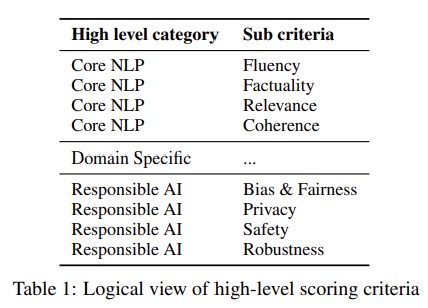
In this position paper, we argue that human evaluation of generative large language models (LLMs) should be a multidisciplinary undertaking that draws upon insights from disciplines such as user experience research and human behavioral psychology to ensure that the experimental design and results are reliable. To design an effective human evaluation system in the age of generative NLP, we propose the ConSiDERS-The-Human evaluation framework, consisting of 6 pillars — Consistency, Scoring Criteria, Differentiating, User Experience, Responsible, and Scalability.

Aparna Elangovan, Ling Liu, Lei Xu, Sravan Bodapati, and Dan Roth, ConSiDERS-The-Human Evaluation Framework: Rethinking Human Evaluation for Generative Large Language Models (ACL 2024)

Winner of the Outstanding Paper Award at the ACL2024 Workshop on Knowledgeable LMs
Is Table Retrieval a Solved Problem? Exploring Join-Aware Multi-Table Retrieval
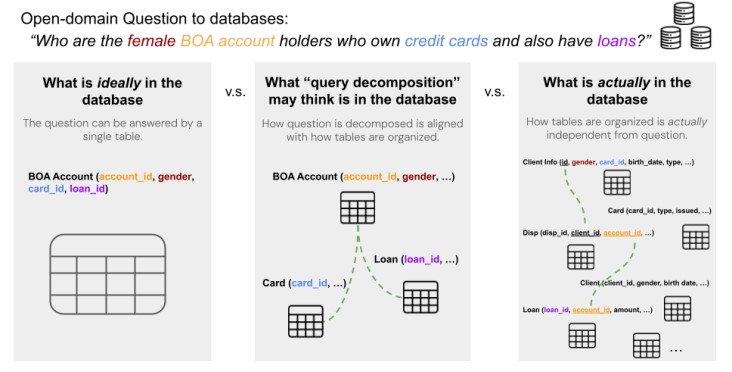
Retrieving relevant tables containing the necessary information to accurately answer a given question over tables is critical to open-domain question-answering (QA) systems. However, many questions require retrieving multiple tables and joining them through a join plan that cannot be discerned from the user query itself. In this paper, we introduce a method that uncovers useful join relations for any query and database during table retrieval. We use a novel re-ranking method formulated as a mixed-integer program that considers not only table-query relevance but also table-table relevance that requires inferring join relationships.

Peter Baile Chen, Yi Zhang, and Dan Roth, Is Table Retrieval a Solved Problem? Exploring Join-Aware Multi-Table Retrieval (ACL 2024)

FlowVQA: Mapping Multimodal Logic in Visual Question Answering with Flowcharts
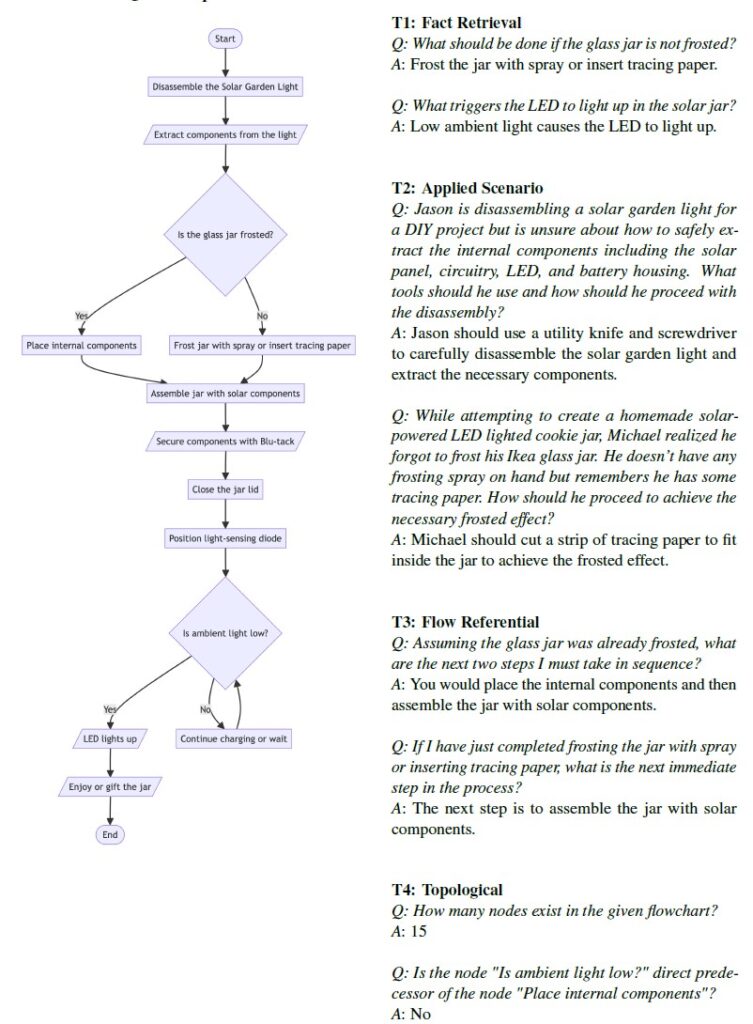
This paper introduces FlowVQA to overcome the shortcomings of existing visual question answering benchmarks in visual grounding and spatial reasoning. FlowVQA features 2,272 flowchart images and 22,413 question-answer pairs to evaluate tasks like information localization, decision-making, and logical reasoning. The evaluation of various multimodal models highlights FlowVQA’s potential to advance multimodal modelling and improve visual and logical reasoning skills.

Shubhankar Singh, Purvi Chaurasia, Yerram Varun, Pranshu Pandya, Vatsal Gupta, Vivek Gupta, and Dan Roth, FlowVQA: Mapping Multimodal Logic in Visual Question Answering with Flowcharts (ACL-Findings 2024)

Evaluating LLMs’ Mathematical Reasoning in Financial Document Question Answering
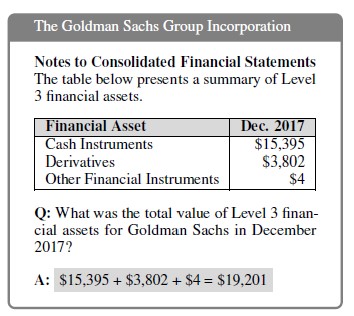
In this paper, we assess LLM robustness in complex mathematical reasoning with financial tabular datasets, revealing that LLMs struggle with increasing table and question complexity, especially with multiple arithmetic steps and hierarchical tables. The new EEDP technique enhances LLM accuracy and robustness by improving domain knowledge, extracting relevant information, decomposing complex questions, and performing separate calculations.

Pragya Srivastava, Manuj Malik, Vivek Gupta, Tanuja Ganu, and Dan Roth, Evaluating LLMs’ Mathematical Reasoning in Financial Document Question Answering (ACL-Findings 2024)